
The Herb Cabinet 本草
黄芩 huáng qín
Scutellaria baicalensis · Baikal skullcap
“One of my three yellows — this one for the upper burner. Where huang lian cools the gut, huang qin cools the chest: hot coughs, bitter mouths, restless heat.” — Lao Xinglin
What the tradition says
The pharmacy keeps three great bitter yellows — huang qin, huang lian, and huang bai — famously dividing the body's three burners between them. Huang qin takes the top: hot phlegmy coughs, high fevers with a bitter mouth, damp-heat in the chest and gallbladder[1]. It also cools the blood in hot bleeding patterns, calms heat-type restlessness in pregnancy (a classical "quiet the fetus" herb), and partners chai hu in the shao yang formulas for lingering half-in-half-out illness[1].
What the research says
Baicalein and baicalin, the root's flavones, are laboratory darlings — anti-inflammatory, antioxidant, and cancer-cell studies abound — but human trials are the missing floor of the building: MSKCC's summary is that larger human safety-and-efficacy studies are still needed[2].
Where to be careful
- Liver: acute liver injury has been reported with products containing skullcap compounds[2] — stop and seek care for fatigue, nausea, dark urine, or yellowing.
- Interactions: it may blunt statins, add to bleeding risk with anticoagulants, and shift CYP-metabolized drug levels[2].
- Tradition's own line: too cold for the cold — pale, chilly, loose-boweled patterns[1].
In the pharmacy
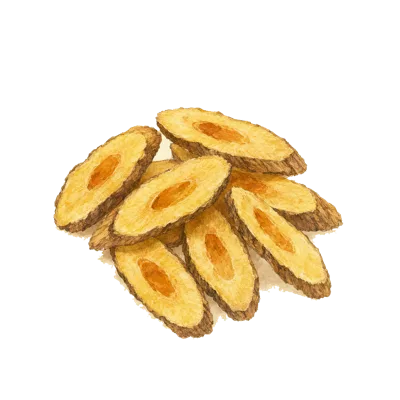
The golden root of Scutellaria baicalensis, sliced to show a hollowing amber core. Not the same plant as American skullcap (S. lateriflora) — different species, different uses, chronically confused on supplement labels.
References
- Bensky, Clavey & Stöger, Chinese Herbal Medicine: Materia Medica, 3rd ed., Eastland Press, 2004. ↩
- Memorial Sloan Kettering Cancer Center, "Scutellaria baicalensis" (About Herbs monograph). https://www.mskcc.org/cancer-care/integrative-medicine/herbs/scutellaria-baicalensis ↩
Under the modern lens
Chemists have catalogued some 426 distinct compounds in huáng qín. The ones their papers return to most often:
Constituent records from SymMap v2.0 and TCMSP, retrieved August 2026 and checked by hand. A list of what's inside is a map, not a promise — chemistry alone doesn't prove an effect.
 Reviewed 2026-08-25