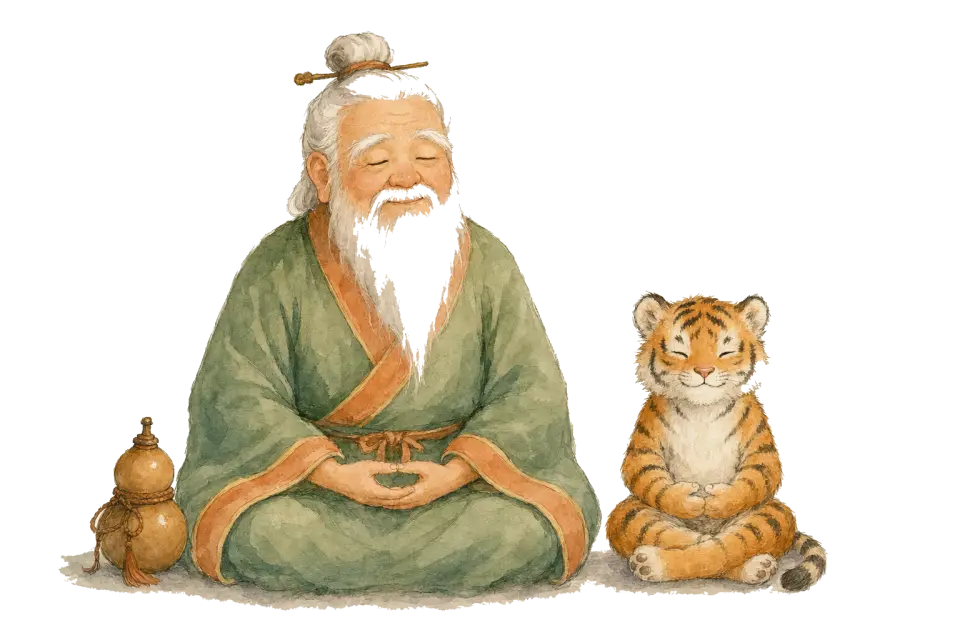
First Principles 基础
Before the herbs make sense, a few ideas have to. These pages explain the tradition's core concepts the way the old doctor would over tea: as a practical language for patterns the body shows, worth understanding on its own terms — neither mystified nor waved away. The classic treatments live here too — moxibustion, cupping, and their kin — each with what the evidence actually shows.
阴阳
Everyone knows the symbol; almost no one was told what it's for. It is not good versus evil. It is the shaded side of the hill and the sunny side — of the same hill.
气
The most argued-over word in the tradition. Come, sit — we'll take it slowly, without incense and without eye-rolling.
艾灸
Fire's half of "acupuncture and moxibustion." We warm the point instead of needling it — with a cigar of mugwort, a cone on ginger, and two thousand years of practice.
拔罐
Yes, the round marks the swimmers had. A flame, a glass cup, a vacuum on the skin — one of the oldest treatments humans have agreed on, and one of the least proven.
五行
Wood, fire, earth, metal, water — not five ingredients, five movements. "Elements" was always a mistranslation; nothing here sits still.
经络
The map acupuncture is drawn on. Twelve main channels, named for organs, charted centuries before anatomy — best understood as the tradition's wiring diagram of function.
子午流注
Why the tradition says 3 a.m. waking is a liver matter and 7 a.m. is breakfast's golden hour. An old scheduling of the organs — part observation, part poetry.
辨证
Two people with the same headache may leave with different formulas, and two different complaints with the same one. This page explains why — it's the tradition's whole method.
针刺
The needles, at last. The tradition's most famous export is also its best-studied — and for once, the honest evidence section has genuinely good news to report.