
The Herb Cabinet 本草
黄连 huáng lián
Coptis chinensis · coptis, goldthread — source of berberine
“The bitterest drawer I own — we say "as bitter as huang lian" the way you say "as cold as ice." Its yellow heart is berberine, which your supplement aisle has recently discovered.” — Lao Xinglin
What the tradition says
Chinese has a proverb for suffering — "eating bitterness like huang lian" — and one taste explains it. This knotted golden root is the pharmacy's strongest fire-clearer: cold and profoundly bitter, it drains heat and dries damp-heat, above all in the gut — dysentery and burning diarrhea are its ancient specialty — and in the heart, where "fire" meant the agitated, sleepless, ulcerated states of heat rising[1]. Red eyes, mouth sores, and hot skin lesions round out the picture. It is dosed in small amounts, in short courses; nobody lingers over huang lian[1].
What the research says — the berberine story
The root's yellow color is berberine, lately a supplement-aisle celebrity. The honest reading of the clinical literature: berberine shows modest improvements in blood sugar, cholesterol, and triglycerides in meta-analyses of mixed quality — real signals, not miracles, and not a substitute for lifestyle change or prescribed treatment[2]. Interest in "nature's Ozempic" framing has far outrun the data.
Where to be careful
- Drug interactions are the big one: berberine inhibits the CYP2D6, 2C9, and 3A4 enzymes that metabolize a large share of medications, and it raises blood levels of immunosuppressants like tacrolimus and cyclosporine[2].
- Pregnancy, breastfeeding, and newborns: no. Berberine can worsen newborn jaundice and risk kernicterus, a serious neurological condition[2].
- Digestive upset is the common side effect[2]; the tradition adds that prolonged use of so cold and bitter an herb damages the digestion it was protecting[1].
In the pharmacy
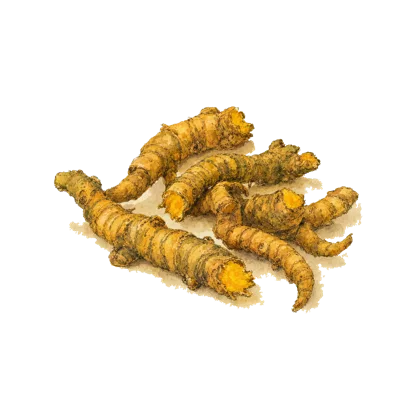
The knotty rhizome of Coptis chinensis — yellow to its core, sold sliced or powdered. The tradition stir-fries it with ginger juice or wine to blunt its coldness for particular jobs[1]. Its cousins goldenseal and barberry carry the same yellow alkaloid; the supplement bottles usually say simply "berberine."
References
- Bensky, Clavey & Stöger, Chinese Herbal Medicine: Materia Medica, 3rd ed., Eastland Press, 2004. ↩
- Memorial Sloan Kettering Cancer Center, "Berberine" (About Herbs monograph). https://www.mskcc.org/cancer-care/integrative-medicine/herbs/berberine ↩
Under the modern lens
Chemists have catalogued some 260 distinct compounds in huáng lián. The ones their papers return to most often:
Constituent records from SymMap v2.0 and TCMSP, retrieved August 2026 and checked by hand. A list of what's inside is a map, not a promise — chemistry alone doesn't prove an effect.
 Reviewed 2026-08-25