
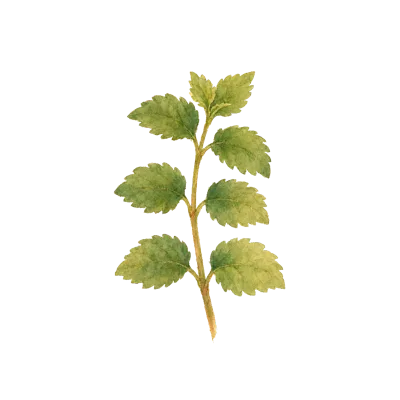
The Herb Cabinet 本草
薄荷 bò he
Mentha haplocalyx · field mint
“A pinch of coolness added at the last minute, lid off, fire out. Mint is the breath of fresh air a stuffy formula — or a stuffy head — is waiting for.” — Lao Xinglin
What the tradition says
Bo he is the pharmacy's open window. Light, aromatic, and cool, it disperses wind-heat — the scratchy throat, headache, and feverishness of a heat-type cold's first day — and clears the head and eyes[1]. Its subtler job appears in Xiao Yao San: a small, late-added pinch helps stuck liver qi vent, the way cracking a lid keeps a pot from rattling[1]. Always added at the end of the boil; its medicine lives in the volatile oils that long cooking destroys.
What the research says
Western research concentrates on its close cousin peppermint, where the evidence is actually respectable: enteric-coated peppermint oil improves IBS symptoms in adults per multiple trials, and topical oil shows limited but suggestive results for tension headache[2]. Field mint (Mentha haplocalyx) itself rides on the genus's pharmacology — menthol and friends — with little direct trial work.
Where to be careful
- Concentrated mint oil is a different animal from mint leaf tea: the oil can cause heartburn and should never be applied to the faces of infants or small children (menthol inhalation risk)[2].
- The tradition keeps this disperser away from the already-depleted and sweating — you don't open windows in a house losing heat[1].
In the pharmacy
Dried leaf and stem of Mentha haplocalyx, unmistakable to the nose. Add in the final minutes of a decoction, lid on briefly, then pour.
References
- Bensky, Clavey & Stöger, Chinese Herbal Medicine: Materia Medica, 3rd ed., Eastland Press, 2004. ↩
- National Center for Complementary and Integrative Health (NIH), "Peppermint Oil: Usefulness and Safety." https://www.nccih.nih.gov/health/peppermint-oil ↩
Under the modern lens
Chemists have catalogued some 389 distinct compounds in bò he. The ones their papers return to most often:
Constituent records from SymMap v2.0 and TCMSP, retrieved August 2026 and checked by hand. A list of what's inside is a map, not a promise — chemistry alone doesn't prove an effect.
Used in formulas
- 逍遥散 Xiao Yao San Free and Easy Wanderer Powder Envoy — a breath of dispersal
- 银翘散 Yin Qiao San Honeysuckle and Forsythia Powder Deputy — cool dispersal through the surface
 Reviewed 2026-08-25