
The Herb Cabinet 本草
白术 bái zhú
Atractylodes macrocephala · white atractylodes rhizome
“Nobody writes poems about bai zhu. It just shows up in half the great formulas and quietly keeps the digestion working — the cabinet's most dependable employee.” — Lao Xinglin
What the tradition says
Every institution has one indispensable, unglamorous member. Bai zhu strengthens the spleen and dries dampness[1]: it treats the fatigue, poor appetite, loose stools, and heavy-limbed sluggishness the tradition reads as a weak digestive middle drowning in its own moisture. From the Four Gentlemen (Si Jun Zi Tang) outward, it anchors the qi-tonic formulas — including Xiao Yao San and Gui Pi Tang — and takes side jobs stabilizing the exterior against sweat, calming a restless fetus in traditional obstetrics, and moving fluids that have pooled where they shouldn't[1].
What the research says
Laboratory work on atractylodes polysaccharides and atractylenolides explores gastrointestinal motility and immune effects, mostly in animals. There is no clinical evidence base to summarize honestly — bai zhu's case is the formulas it serves in, and the tradition's long confidence.
Where to be careful
Its drying warmth is the point and the limit: the tradition withholds it where yin is depleted — thirst, dryness, night heat[1]. Otherwise it sits among the pharmacy's gentlest tools, eaten in medicinal porridges for centuries.
In the pharmacy
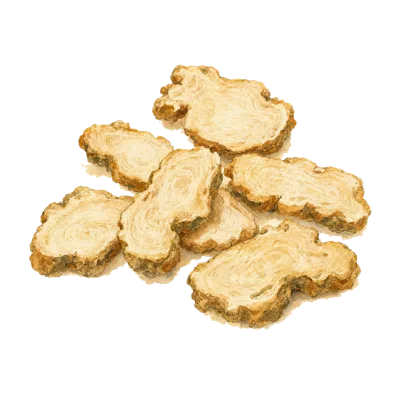
The knobby rhizome of Atractylodes macrocephala, sliced tan with a resinous fragrance. Dry-fried (chao bai zhu) leans further into spleen-strengthening; the earth-fried version toward stopping diarrhea[1]. Its pungent cousin cang zhu (苍术) is the rougher, stronger-drying sibling.
References
- Bensky, Clavey & Stöger, Chinese Herbal Medicine: Materia Medica, 3rd ed., Eastland Press, 2004. ↩
Under the modern lens
Chemists have catalogued some 188 distinct compounds in bái zhú. The ones their papers return to most often:
Constituent records from SymMap v2.0 and TCMSP, retrieved August 2026 and checked by hand. A list of what's inside is a map, not a promise — chemistry alone doesn't prove an effect.
Used in formulas
- 逍遥散 Xiao Yao San Free and Easy Wanderer Powder Assistant — strengthens the spleen
- 归脾汤 Gui Pi Tang Restore the Spleen Decoction Deputy — strengthens the spleen
- 四君子汤 Si Jun Zi Tang Four Gentlemen Decoction Deputy — strengthens the spleen, dries damp
- 玉屏风散 Yu Ping Feng San Jade Windscreen Powder Deputy — strengthens the spleen that feeds the defense
- 补中益气汤 Bu Zhong Yi Qi Tang Tonify the Middle and Augment the Qi Decoction Deputy — strengthens the spleen
 Reviewed 2026-08-25